

This post, like all Unusual Assets posts, is for entertainment and educational purposes only and is not financial, legal, or any kind of advice.
Jack Dorsey’s first tweet was not really his first tweet. It was his 20th, and the rest are lost to time. (We know this because Twitter’s internal Tweet counter lists it as #20, with every tweet following it proceeding sequentially upwards.)
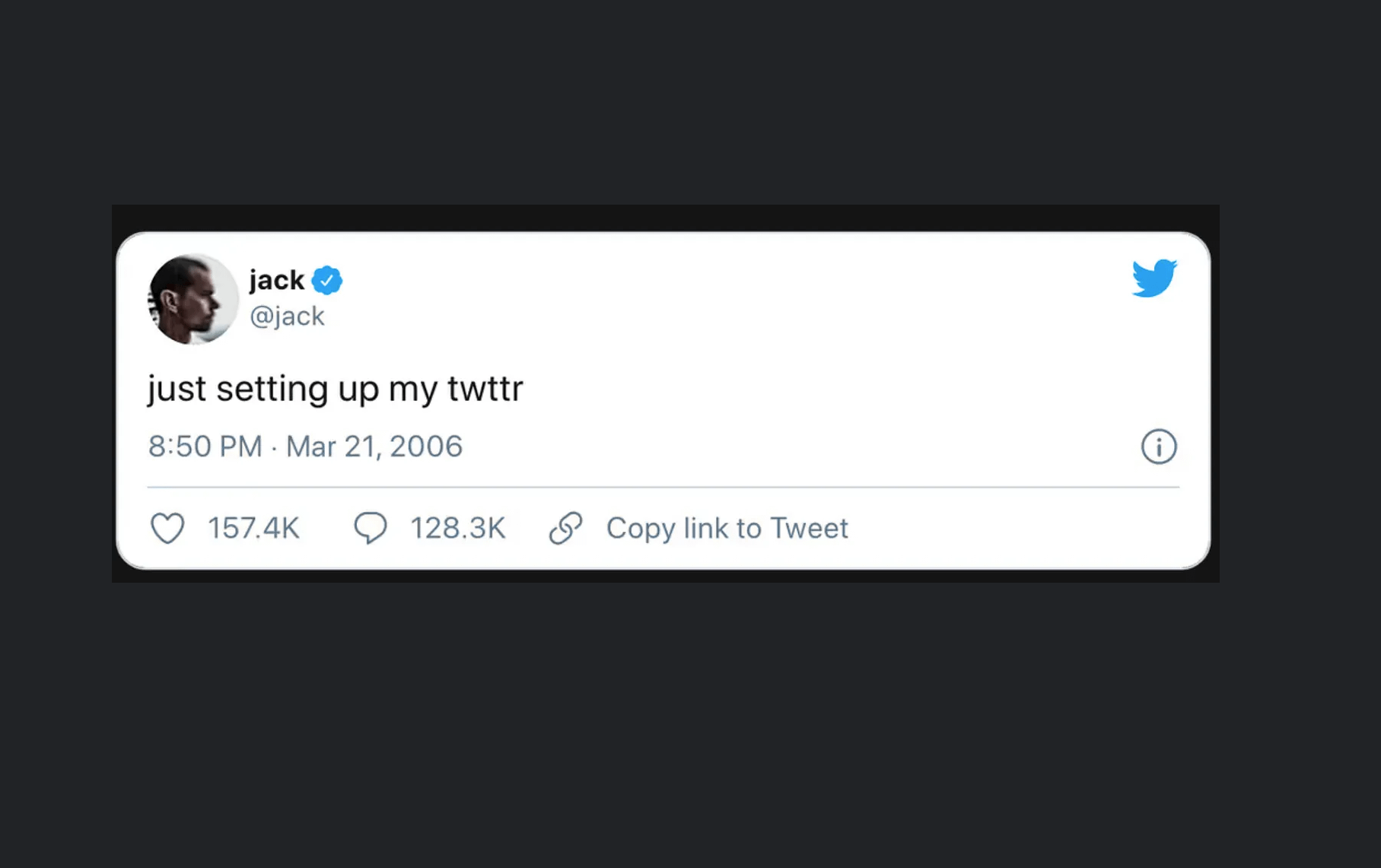
That did not stop “@jack” from selling an NFT of this “first” tweet during the NFT craze. It sold for 2.9 million to a man to tried to resell it for $48 million, with the promise to donate $25 million of that to charity.
It is now worth less than $5 according to several viral online sources, which appear to cite failed auctions and/or a tracker on OpenSea. That pricing is basically wrong but not far off, because there are currently offers to buy it for more (though not much more).
This NFT goes viral every few months, mostly because people love to see rich people do stupid things, Twitter is famous, NFTs are mostly seen as dumb, and it’s a good story.
What’s it worth?
You can see the listing online at Opensea, and there are two current bids for it. The highest is for .012 Ethereum, which works out, right now, to be about $27 US Dollars. At an earlier auction, the highest bid was $6222, but the owner said he would probably never sell.
What’s the deal with NFTs?
While it seems a legitimately foolish purchase, and could just be written off as a cautionary tale, if you squint you can almost see how the NFT bubble came about.
The underlying idea was real: a way to prove ownership of a specific digital thing on a public ledger, portable across platforms, not dependent on any single company staying in business. That’s genuinely useful for tickets, credentials, deeds, in-game items, provenance for luxury goods — anywhere ownership matters and platforms can’t be trusted to outlive the asset.
In short, it was a way of trying to create scarcity in a digital world. A world where scarcity is not normal. You can copy a file 1,000,000 times and it will be exactly the same. A Picasso can’t be copied exactly, although some have tried.
But a Picasso can’t be copied for many reasons, including it’s age, the provenance, and the difficulty of painting something exactly the same. An art print is not the same as a painting, and a fake painting is very expensive to make and hard to sell. A fake digital file, on the other hand, is easy to make, free to spread, and is functionally the same for many people.
NFTs, in some ways, misunderstood some of what people care about when they buy items.
What’s so memorable, and unusual, about this NFT is that it has gone beyond a mere cautionary example of the NFT bubble. It’s a reminder of two historical moments that were both built on half-truths. The tweet was never actually the first tweet, and NFTs, as pitched in the early 2020s, were never likely going to be the financial investment they were promised to be.
Overvalued or undervalued?
At $27 this is clearly undervalued, both financially and culturally.
Financially, it is a curiosity which goes viral every few months or years, and when it does sell, at whatever price, the press alone will be worth something. What that number is I can’t say, but it’s a lot more than $27.
Culturally, it’s worth more than that as a reminder of the NFT craze and as a historical moment. Even just telling someone at a party you owned that would be worth more than $27.
This post, like all Unusual Assets posts, is for entertainment and educational purposes only and is not financial, legal, or any kind of advice.